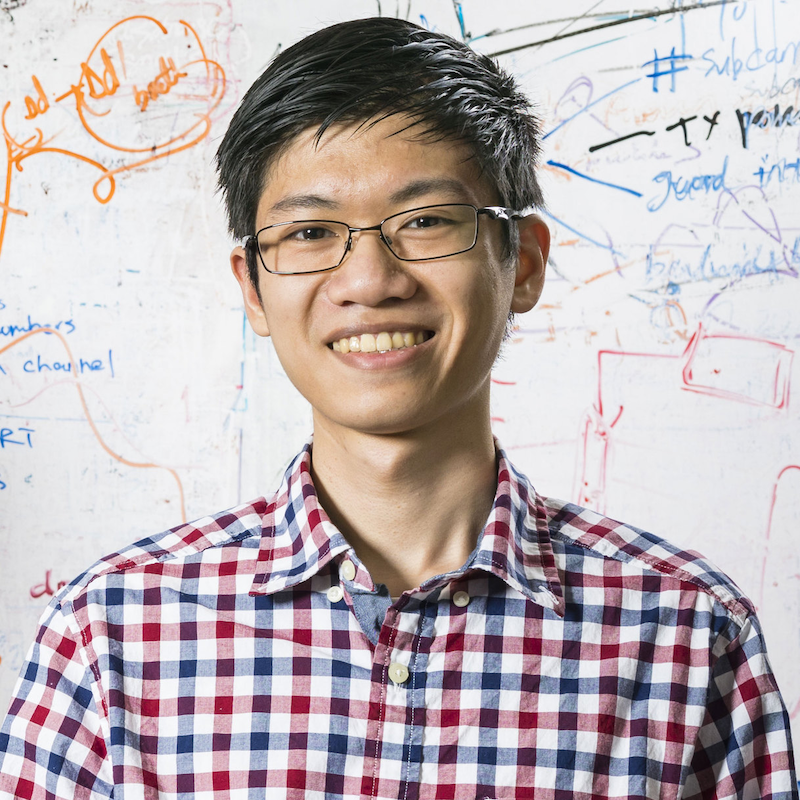
Justin Chan
Assistant Professor, Electrical and Computer Engineering
Contact
Pittsburgh, PA 15213
Pittsburgh, PA 15213
Bio
Justin Chan is an Assistant Professor in the Electrical and Computer Engineering Department and the Software and Societal Systems Department at Carnegie Mellon University. His research focuses on building intelligent mobile and embedded systems for computational health and large-scale environmental sensing.
His work on smartphone-based ear infections is now FDA-listed and is available to select early access healthcare systems. His work on new-born hearing screening has led to an international effort called TUNE with the goal of bringing universal newborn hearing screening across Kenya as well as collaborations with NGOs such as the Global Foundation for Children with Hearing Loss to deploy this technology in Nepal and Mongolia. His work on contactless cardiac arrest detection has been licensed to a startup which has recently been acquired by Google. He was also a lead contributor for CovidSafe (now WA Notify), a COVID-19 contact tracing and symptom tracking app, which became part of official efforts by the WA Department of Health to manage the pandemic. He has authored publications in interdisciplinary journals like Nature Biomedical Engineering, Science Translational Medicine, Nature Communications as well as Computer Science and Engineering venues like MobiSys, MobiCom, SIGCOMM, SIGGRAPH Asia and UIST.
His work on smartphone-based ear infections is now FDA-listed and is available to select early access healthcare systems. His work on new-born hearing screening has led to an international effort called TUNE with the goal of bringing universal newborn hearing screening across Kenya as well as collaborations with NGOs such as the Global Foundation for Children with Hearing Loss to deploy this technology in Nepal and Mongolia. His work on contactless cardiac arrest detection has been licensed to a startup which has recently been acquired by Google. He was also a lead contributor for CovidSafe (now WA Notify), a COVID-19 contact tracing and symptom tracking app, which became part of official efforts by the WA Department of Health to manage the pandemic. He has authored publications in interdisciplinary journals like Nature Biomedical Engineering, Science Translational Medicine, Nature Communications as well as Computer Science and Engineering venues like MobiSys, MobiCom, SIGCOMM, SIGGRAPH Asia and UIST.
Education
Ph.D. (expected 2023)
M.S. 2018Computer Science & Engineering
University of Washington
A.B. 2015
Computer Science
Dartmouth College